
In this guide
The Dry Weight Trap: Understanding True Wet Operating Weight
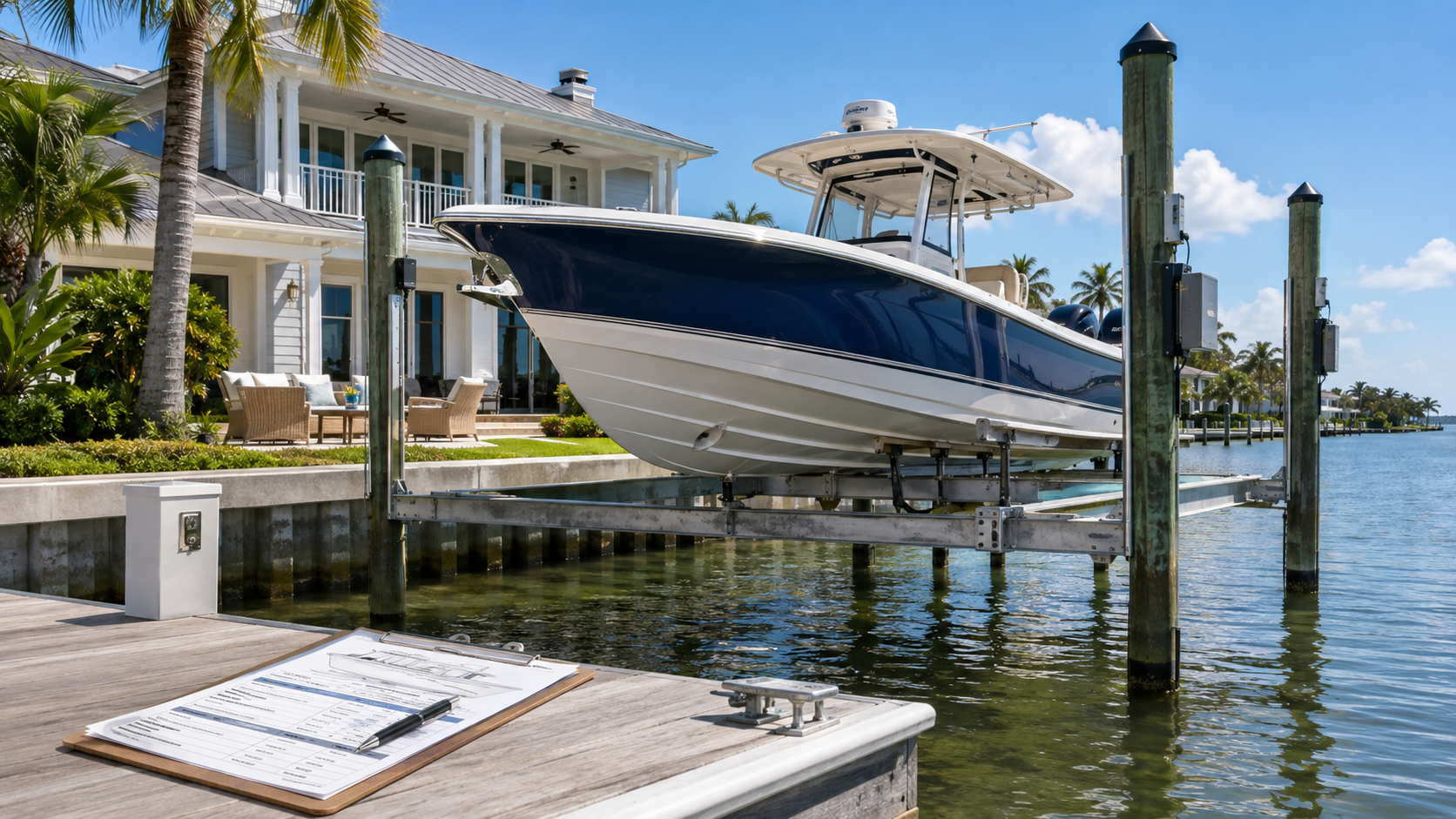
When purchasing a waterfront home along the Florida Gulf Coast, buyers often assume an existing boat lift will support their vessel simply because the lift's stated capacity exceeds the boat's published specification sheet. In practice, manufacturer spec sheets list dry weight, which excludes outboards, fuel, fresh water, safety equipment, personal gear, and custom marine accessories.
Standard residential boat lifts typically carry ratings between 5,000 and 10,000 or more pounds. To determine if an existing system will safely hoist a vessel, buyers must calculate full wet operating weight. Relying on dry figures frequently leads to severe structural overload or mechanical failure.
Wet Operating Weight = Hull Dry Weight + Outboard Engine(s)
+ Fuel Capacity (Gallons × 6 to 7 lbs)
+ Water Capacity (Gallons × 8 lbs)
+ Gear & Accessories (500 lbs or 15% of Loaded Weight)
Required Lift Capacity = Wet Operating Weight + 15% to 25% Safety Margin
Fuel weight adds 6 to 7 pounds per gallon, while onboard water tanks add approximately 8 pounds per gallon. T-tops, towers, electronics, generators, ground tackle, and personal gear add hundreds of additional pounds. Industry sizing guidelines recommend adding a 15% to 25% safety buffer above total wet weight before selecting or approving a lift.
Wet Weight Calculations in Practice
To illustrate how quickly real-world loads accumulate, consider common recreational setups compared across dry weight and full operating configuration.
| Component | Mid-Size Center Console | Weight Impact Calculation |
|---|---|---|
| Base Hull Dry Weight | 2,250 lbs | Published spec sheet only |
| Outboard Engine | 750 lbs | Mounted propulsion |
| Fuel Tank (80 gal) | 560 lbs | Calculated at 7 lbs per gallon |
| Fresh Water Tank (20 gal) | 160 lbs | Calculated at 8 lbs per gallon |
| Gear & Accessories | 558 lbs | Calculated at ~15% of loaded vessel |
| Total Wet Operating Weight | 4,278 lbs | Baseline required hoist weight |
| Recommended Lift Capacity (+20%) | 5,134+ lbs | Standard 5,000 lb lift is insufficient |
Hull Geometry, Beam Width, and Cradle Alignment
Weight capacity is only half of the compatibility equation. A boat lift cradle and bunk layout must also match the specific geometry and beam width of the vessel. The cradle must provide adequate interior clearance between lift pilings to accommodate the widest point of the boat.
Specialized hull designs introduce distinct bunk positioning requirements. Pontoon and tritoon vessels, for instance, require cradle bunks positioned precisely to support outer tubes or all three pontoons evenly across the frame.
Inspecting Pilings, Hardware, and Existing Dock Framing
Even a correctly sized lift mechanism will fail if the underlying pilings and dock framing cannot handle the transferred load. When evaluating a waterfront home, buyers must inspect the physical integrity of the entire mooring structure.
Structural Due Diligence Checklist for Existing Lifts
- Examine wood pilings for rot, marine borer damage, structural shifting, and lateral movement.
- Inspect dock framing, stringers, and decking for loose, warped, or deteriorating members.
- Check lift cables, pulleys, and cradle crossbeams for corrosion, spalling, or mechanical wear.
- Verify marine-grade stainless steel or hot-dip galvanized hardware at all structural connections.
- Confirm cleat attachment points and ensure overall dock size is sufficient to secure the boat during adverse weather.
Upgrades, HOA Rules, and Engineering Approvals
If an existing lift cannot support your boat or if you plan to upgrade from a standard residential lift to a heavier hoist, retrofitting requires careful verification of dock layout, piling placement, and water depth. Expanding a dock footprint or driving heavier pilings requires multiple layers of review.
Michael's Expert Takeaways
Related Seaside Resources
See the yacht makes and models we broker when you are sizing the boat before the dock. See the Dock-to-Deck assessment where we check depth, clearance, and lift capacity against a specific vessel. See the boat lift planning guide before you commit to a lift capacity or a piling layout. See the Coastal Insights library for the rest of the series.
Frequently asked questions
Why is manufacturer dry weight insufficient for sizing a boat lift?
Dry weight reflects only the bare hull. It excludes engines, fuel (6 to 7 lbs/gal), fresh water (8 lbs/gal), batteries, towers, canvas, safety gear, and accessories, which together can add thousands of pounds.
What safety margin should be added to a boat's wet weight?
Marine industry standards recommend choosing a boat lift rated 15% to 25% (or a minimum of 20%) above the fully loaded wet operating weight of the vessel.
Can wide-beam boats or catamarans fit on standard four-post lifts?
Standard residential four-post lifts are frequently too narrow for catamarans and wide-beam trawlers. Lift cradle width, piling spacing, and custom bunk configurations must be verified for wide or multi-hull boats.