
In this guide
Waterway Constraints and Lift Architecture
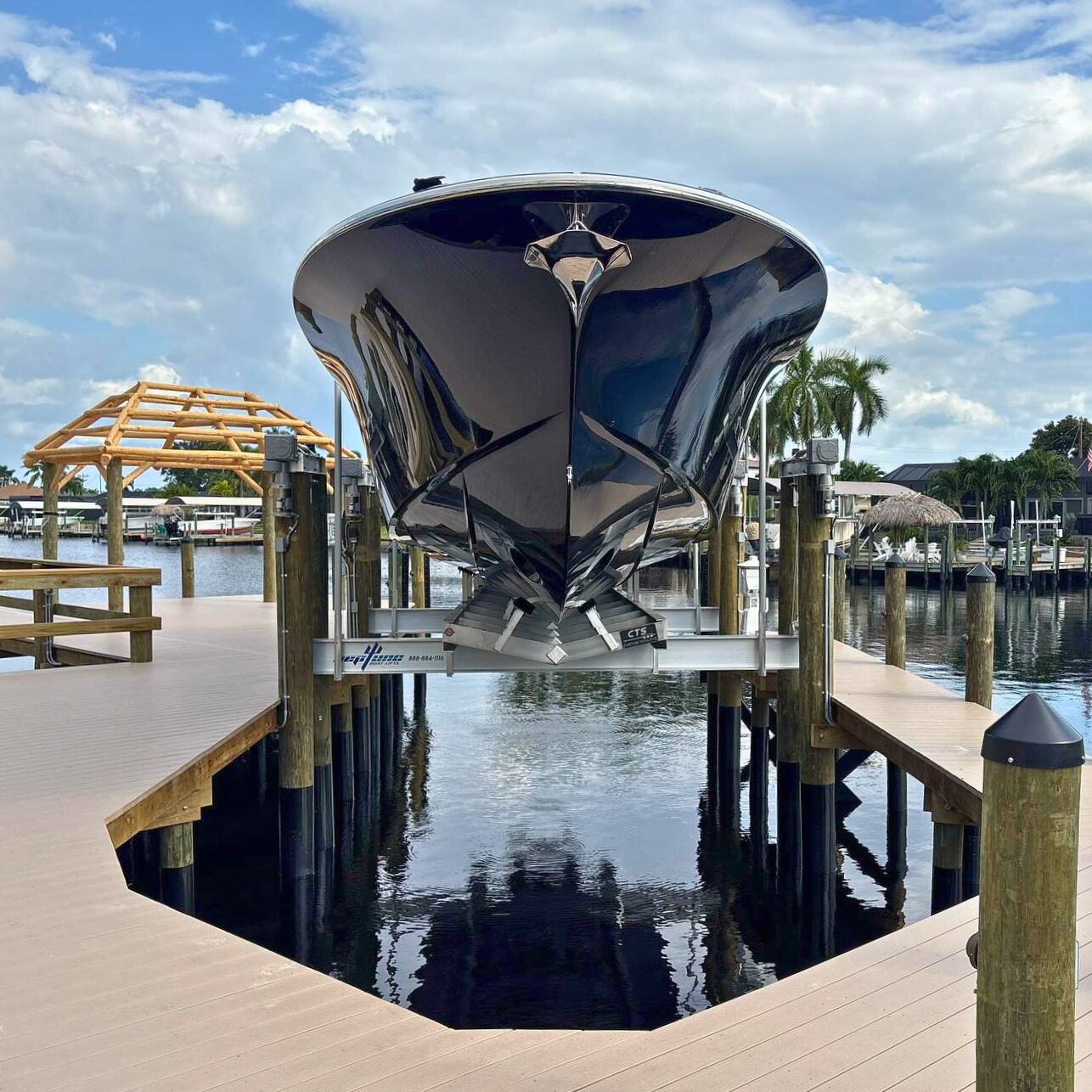
Selecting a boat lift along Florida's Gulf Coast requires evaluating how the mechanical design interacts with local waterway geography. Waterfront properties in Sarasota, Venice, and surrounding coastal areas range from tight residential canals to open bayfronts. The three primary lift mechanisms—traditional multi-post vertical lifts, track-mounted elevator lifts, and hydraulic systems—each serve distinct structural and environmental profiles.
Where navigable channel space is constrained or local regulations restrict outer piling placement, traditional four-post configurations may not be feasible. In these settings, lift architecture must maximize clearance while securely supporting the vessel's hull.
| Lift Mechanism | Mounting Architecture | Best Waterway Application | Key Considerations |
|---|---|---|---|
| Elevator Lift | Seawall, dock, or single-row pilings | Narrow canals, shallow channels, restricted slips | Inward travel path; requires strong seawall or piling support |
| Bottom-Standing Elevator | Wide footplates resting on seabed | Shallow, soft-bottom canals (e.g., Osprey, Nokomis) | Disturbance over 200 sq ft can trigger additional FDEP review |
| 4-Post Vertical Lift | Four or more driven timber/concrete pilings | Open bayfronts, wide canals, standard basins | Account for over 50% of market; requires adequate waterway width |
| Marine Hydraulic Lift | Piling or cantilevered framework | Deep-water docks, high-current areas, rougher water | High lifting speed (>3 ft/min); requires sealed hydraulic systems |
Elevator Lifts for Narrow Canals and Soft Bottoms
Elevator boat lifts operate along rigid vertical or angled I-beam tracks mounted directly to a reinforced seawall, dock structure, or single line of pilings. As the cradle raises the boat, it travels along the track, moving the vessel slightly inward toward the shore. This inward path preserves essential navigation clearance in narrow canals and tight slips where outboard pilings are impractical or legally restricted.
For shallow, soft-bottom waterways—such as sections of Osprey, Nokomis, and southern Little Sarasota Bay—bottom-standing elevator lifts offer an alternative to driving deep pilings. These systems utilize a wide footplate that rests directly on the seabed, raising the vessel using a column or scissor mechanism.
Engineered track-mounted elevator lifts can support capacities exceeding 20,000 lbs. However, mounting directly to a seawall requires verified structural integrity, ensuring the concrete wall can handle combined dead weight and dynamic loads without compromising shoreline stability.
Vertical Pilings and High-Speed Hydraulic Systems
Traditional multi-post vertical lifts represent over 50% of all boat lifts sold due to their adaptability across fluctuating water levels and reliable multi-cable load distribution. These lifts suspend the boat cradle between four or more driven pilings, making them a standard fixture along open bays and wider canal basins where channel width allows for outer piling placement.
In deeper water lots, riverfront properties, and open waterways subject to tidal currents and wake turbulence, hydraulic lifts are increasingly preferred. Premium marine hydraulic systems achieve lifting speeds exceeding 3 feet per minute, rapidly elevating the hull out of rough water.
A properly specified 20,000 lb hydraulic lift installed on a deep-water parcel with direct bay access represents a significant structural asset that enhances long-term property utility and market value.
Materials and Environmental Engineering for Saltwater
The subtropical marine climate of Southwest Florida subjects mechanical dock hardware to continuous salt spray, high humidity, solar radiation, and tidal movement. Selecting appropriate lift construction materials prevents rapid corrosion and unexpected mechanical failure.
Key Specifications for Saltwater Boat Lifts
- Marine-grade aluminum construction for primary structural cradles and top beams (used in 68% of new lifts)
- High-grade stainless steel cables, fasteners, and mounting hardware
- Sealed drive gearboxes or enclosed hydraulic power units to prevent water intrusion
- Corrosion-resistant backing plates and hardware for seawall-mounted brackets
- Routine rinse schedules and scheduled mechanical servicing to manage annual coastal wear
Waterfront Due Diligence Checklist
Before purchasing a waterfront property or contracting for a new lift installation, buyers must confirm whether the existing structure and local regulations align with their intended vessel.
Pre-Purchase Lift Due Diligence
- Review existing lift capacity plates, manufacturer documentation, and recent service records
- Inspect seawall condition and tie-back integrity if considering a seawall-mounted elevator lift
- Confirm canal width and local municipality setbacks to avoid navigation fairway encroachment
- Check HOA bylaws regarding lift roof canopies, maximum beam allowances, and piling extensions
- Verify water depth at mean low water across the entire approach channel and slip footprint
Frequently asked questions
When is an elevator lift required instead of a 4-post vertical lift?
Elevator lifts are typically required in narrow canals or restricted slips where local regulations, rock walls, or channel widths prohibit outer pilings, or where mounting directly to a seawall or single dock edge is necessary to preserve navigation space.
What are the advantages of hydraulic boat lifts in Florida coastal waters?
Marine hydraulic lifts provide rapid lifting speeds exceeding 3 feet per minute, allowing boaters to quickly raise vessels out of turbulent water, wake exposure, and strong tidal currents, while eliminating overhead cable assemblies.
Can an elevator lift be installed on any seawall?
No. Seawall-mounted elevator lifts transfer significant dynamic and static loads to the seawall structure. A qualified marine contractor or engineer must inspect the concrete, cap, and tie-back system to verify structural capacity prior to installation.